Organizer

-
Mondeggi Common Good - Farm Without Masters
-
Email
versomondeggibenecomune@inventati.org -
Website
https://mondeggibenecomune.org/

- Via di Mondeggi, 50012 Bagno a Ripoli, FI
Category

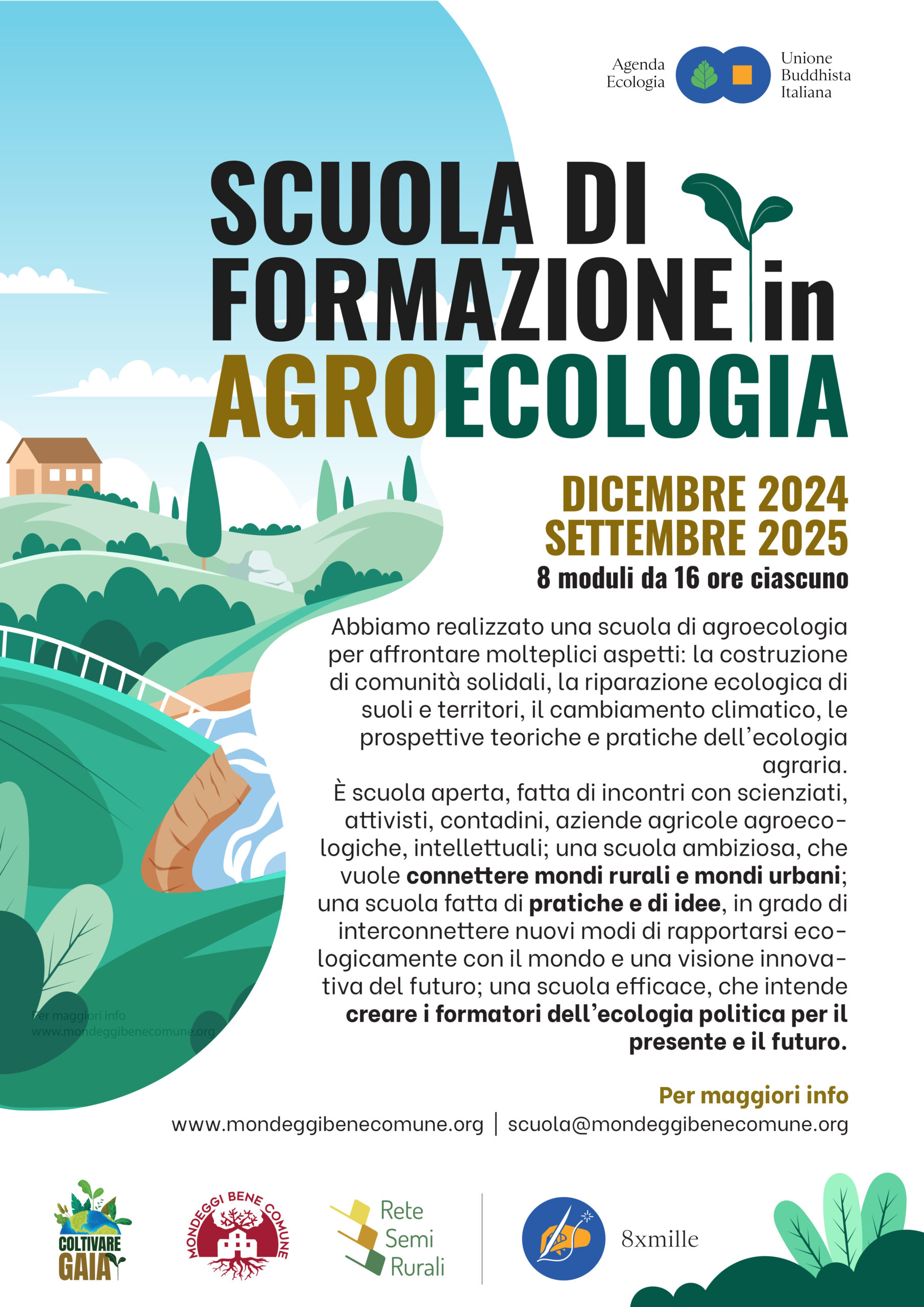
CULTIVATE GAIA: Training School in Agroecology.
We have created a school of agroecology to address multiple aspects: building supportive communities, ecological repair of soils and territories, climate change, theoretical and practical perspectives of agrarian ecology. It is an open school, made up of meetings with scientists, activists, farmers, agroecological farms, and intellectuals; an ambitious school, which wants to connect rural and urban worlds; a school made up of practices and ideas, capable of interconnecting new ways of relating ecologically to the world and an innovative vision of the future; an effective school, which intends to create the trainers of political ecology for the present and the future.
THE SCHOOL.
“Cultivating Gaia” is a project curated by Mondeggi Bene Comune-Fattoria Senza Padroni, Rete Semi Rurali and the Ecology Agenda of the Italian Buddhist Union. Cultivate Gaia aims to connect the worlds of ‘back to the land’ with urban mobilizations in defense of territories, the knowledge of agroecology with that of political ecology, ecological thinking and everyday practices of ecological transition: we want to create and share knowledge, network and build a path of training and research for socioecological transformation that is at the intersection of solidarity community building and ecological repair of soils and territories.
This is a training and research course consisting of 8 modules of 16 hours each. The school will start in December 2024 and conclude in September 2025, for a total of 128 hours of “training for trainers” aimed at creating the new agroecology ambassadors and ambassadors. The course will take place in Tuscany in different locations and facilities, located between the city of Florence and its countryside.
Detailed program at: mondeggibenecommune.
WHAT IS AGROECOLOGY?
Agroecology is a paradigm shift from ‘intensive, anthropocentric, ecosystem-destroying agriculture toward a care and regeneration of the soil and the beings that inhabit it. It is a growing movement based on the relationships
ecological within communities. It consists of producers and producers of genuine, organic food, and aims to develop a new political, economic and legal way of acting based on the principles of biocentrism. Agroecology is a concrete transformative politics that is based on experimenting with alternative relationships between humans and (T)land. Agroecology, in our perspective, is first and foremost the creation of alternative ways to deal with the ecological interdependencies involved in agrifood production processes. For us, the formula “becoming a farmer” represents a transition to a way of life in which work and ecological care are inextricably intertwined, beginning with the reinvention of everyday practices. The desire for a daily, direct, material relationship with the land characterizes this peasant renaissance. More than a job, the word “peasant” evokes an alternative form of life, a secession from the monoculture of economic, material and cultural productivism. It can be interpreted not only as a science that is transforming our understanding of the soil, or a set of practices that is reshaping the everydayness of agriculture, but also as a movement that redefines the political, economic and legal space of action for producers of genuine, organic food.
WHY?
Since the 1940s, the destructive practices of the so-called “green revolution” have significantly transformed agriculture on a global scale. The adoption of new technologies, the central role of mechanization, the selection of high-yielding grain varieties, and the extensive use of chemical fertilizers are the main features of industrial agriculture. These food production technologies have broad socio-ecological implications in relation to biodiversity and climate change, and involve a highly dependent relationship between farmers and the world’s largest chemical producers. Agroecology now stands as a necessary choice to overcome the contradictions generated by the “green revolution.”
It is a process of transformation and repair of our food systems and rural worlds that starts with the ecological practices of peasants, farmers, artisanal fishers, pastoralists, local communities and urban food producers. It brings together all those cultures that
Are marginalized by exacerbated industrialism.
CONTENTS
Our training in agroecology aims to process and share cultural, technical, scientific, philosophical and political knowledge, with the goal of building communities of solidarity and generative ecological relationships. “Cultivating Gaia” is an open school, made up of classroom and field meetings with scientists, activists, farmers, representatives of indigenous peoples and agroecological farms. An ambitious school that wants to connect, through the theme of soil repair, rural and urban worlds.